Not every tone feels good. Some people find a certain frequency harsh, buzzy, unsettling or headache-inducing. That’s normal, and usually fixable. Here’s why it happens and what to do about it.
1. It’s too loud
This is the most common cause by far. Binaural beats and frequency tones are meant to be quiet. At high volume, even a gentle tone becomes tiring, and high-pitched tones become piercing.
Fix: turn it down until it’s just above the background noise in the room. You should be able to talk over it.
2. The pitch is high
Our ears are most sensitive in the upper-mid range, roughly 2,000 to 5,000 Hz. Tones up there can feel sharp fast. Even tones around 700 to 1,000 Hz, like some of the higher solfeggio frequencies, can feel bright.
Fix: choose lower tones, or lower the volume more for higher ones. My custom preset uses 963 Hz, and I keep it quieter than my other tones for exactly that reason.
3. Clicks, pops and harsh edges
A tiny click when a sound loops or switches is like a tap on the shoulder every few seconds. It keeps your brain on alert and can make a calm tone feel irritating. A lot of apps have this problem. My app did too, at first. I took the time to make every tone in Binaural Tones seamless, with no clicks on loops, starts, stops or switches.
Fix: if you hear clicks, it’s the app, not you. Try a different source.
4. The beat is too fast for the moment
A 40 Hz Gamma beat at bedtime or an 18 Hz Beta beat when you’re already anxious can feel jittery. The brainwave bands have different jobs. (Here’s my field guide to the bands.)
Fix: drop to a slower band, or use a Morphing journey like Deep Relax that eases you down gradually. Here’s why gradual shifts feel better.
5. Pulsing tones bother you
Isochronic tones switch on and off, and some people find that rhythm distracting or uncomfortable.
Fix: switch to a smooth binaural beat or a steady harmonic drone instead.
6. Uneven hearing or a bad headphone fit
If one ear is louder, or one earbud sits loose, the tone can feel lopsided or strange.
Fix: reseat your headphones, center the balance and turn off mono audio. Here’s my guide to headphones for binaural beats.
7. It’s just not your tone
Sometimes a frequency simply doesn’t sit right with you, and that’s fine. Everyone responds differently. (More on that in why binaural beats work better for some people.)
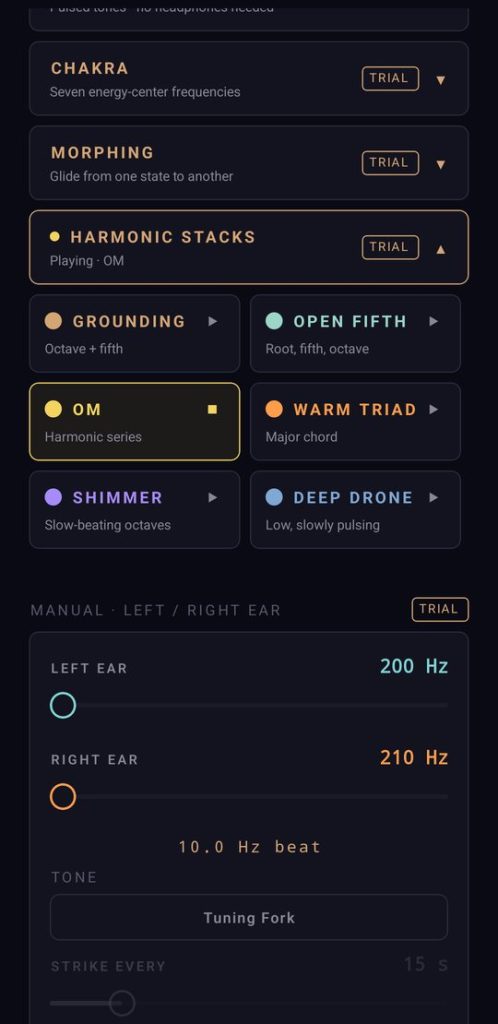
Fix: try a different preset, or build your own with the manual sliders and save what feels good.
When to stop
If you get dizziness, a headache that doesn’t go away, ringing in your ears or a sense of panic, stop listening. Try again another day at a lower volume with a different tone, and talk to a doctor if it keeps happening. If you have epilepsy or a condition affected by sound, check with your doctor before using rhythmic tones at all. See Are Binaural Beats Safe?
Try it yourself
You can hear a five-second sample of every preset, free, on the Try It page. If you want the full experience, download Binaural Tones on Google Play. Everything is unlocked for your first 24 hours. Try everything, then let me know what you thought.
Binaural Tones is a relaxation and focus aid, not a medical treatment. This post is general information, not medical advice. If you have epilepsy or any condition affected by sound, check with your doctor before using it.