Ask ten people about binaural beats and you’ll get ten different answers. Some feel calm within minutes. Some feel nothing. Some find them annoying. If you’re in the “nothing happened” camp, it doesn’t mean they can’t work for you. It might just mean the setup isn’t right for your brain yet.
Reason 1: Not everyone hears the beat the same way
The beat isn’t in the audio. Your brain creates it by comparing what your two ears hear. How clearly you perceive it depends on your hearing, the balance between your ears, and the tone itself. The illusion is strongest with lower tones (under about 1,000 Hz) and smaller differences between the ears. If one ear hears a bit better than the other, the effect can be weaker.
Reason 2: The setup is wrong
- No headphones. Speakers mix the tones together in the air. Binaural beats need a separate signal for each ear.
- Mono audio is turned on. Many phones have an accessibility setting that sends the same sound to both ears. It completely cancels a binaural beat. Check it.
- Spatial or surround effects. Some headphones and phones process audio in ways that blur the left/right split.
- Too loud. Volume past comfortable makes it harder to relax and easier to get a headache.
My guide to the best headphones for binaural beats covers all of this.
Reason 3: Poor sound quality
A click every time a loop restarts or a pop when you switch tones is enough to keep your brain on alert. I had those clicks in the early versions of my own app, and I could feel how much they broke the experience. That’s why I took the time to make every tone in Binaural Tones seamless. If an app you’ve tried felt jarring, the problem may have been the audio, not you.
Reason 4: The wrong frequency for you
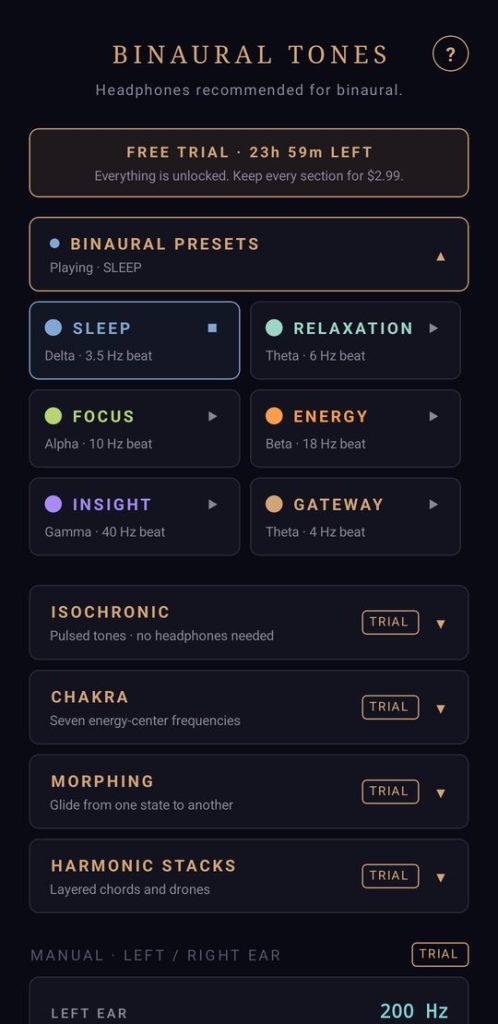
Brainwave bands are a guide, not a rule. My own favorite focus preset breaks the rule completely: 963 Hz in my left ear and 965 Hz in my right. That’s a 2 Hz beat, technically in the “sleep” range, but the bright tone keeps me sharp and focused. If the textbook frequency doesn’t work for you, try others or build your own. That’s exactly why I built manual sliders into the app. Here’s how to choose the right frequency.
Reason 5: Expectations and consistency
If you listen once for two minutes while scrolling your phone, you probably won’t notice much. Binaural beats work best as a practice: same tone, same time, 20 minutes or more, for a week. See how long, how often and when to listen.
Reason 6: Brains are different
I have ADD, and binaural beats help me focus and block out distractions in a way nothing else does. Other people respond more to the relaxation side. The research reflects this too: results vary a lot from person to person, which is part of why studies disagree. I believe the brain is more powerful than most of us can imagine, and every one of them responds a little differently.
How to find what works for you
- Check your headphones and turn off mono audio.
- Lower the volume.
- Try each section: Binaural, Isochronic, Morphing, Chakra and Harmonic Stacks.
- Give each one a real 20-minute session.
- Build a custom beat if nothing quite fits.
Try it yourself
You can hear a five-second sample of every preset, free, on the Try It page. If you want the full experience, download Binaural Tones on Google Play. Everything is unlocked for your first 24 hours. Try everything, then let me know what you thought.
Binaural Tones is a relaxation and focus aid, not a medical treatment. This post is general information, not medical advice. If you have epilepsy or any condition affected by sound, check with your doctor before using it.