There are a lot of ways to quiet your mind: guided meditation apps, white noise, calming music, breathwork, singing bowls and binaural beats. They’re not competitors so much as different tools for different moments. Here’s how binaural beats compare, and when I reach for each.
Guided meditation apps
Best for: beginners and anyone who wants someone to talk them through it.
A voice telling you what to do is great when you’re learning. The downside is that the voice itself can become a distraction once you know the basics, and it’s hard to use while working.
Compared with binaural beats: beats have no voice to follow, which makes them better for longer sessions and for focus while you work.
White noise and nature sounds
Best for: masking background noise and sleeping in a loud space.
White noise is great at covering sounds, but it doesn’t do much beyond that.
Compared with binaural beats: beats also mask distractions, and they add a rhythm aimed at a specific state, like Alpha for focus or Delta for sleep.
Calming music
Best for: mood and enjoyment.
Music is wonderful, but melodies and lyrics give your brain something to follow, which can pull you away from your task or your breath.
Compared with binaural beats: beats are deliberately boring in the best way. Nothing to follow, nothing to react to.
Breathwork
Best for: shifting your state quickly, and it’s free.
Slow breathing is one of the most reliable ways to calm your body.
Compared with binaural beats: they work beautifully together. Let a slow tone set the pace while you breathe.
Singing bowls, tuning forks and drones
Best for: a rich, resonant focal point.
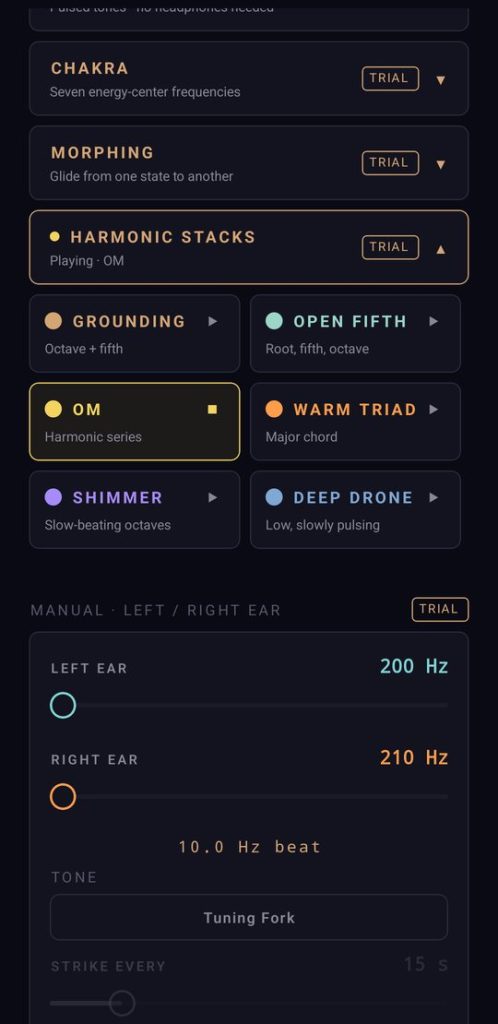
These are the closest relatives to frequency tools. In Binaural Tones, the Tuning Fork setting gives you a struck tone that rings and re-strikes, and the Harmonic Stacks give you layered drones.
Where binaural beats shine
- Focus while working. This is my main use. I have ADD, and binaural beats help me block out distractions and stay centered in a way none of the other tools do. Here’s my take on binaural beats for focus.
- Shifting your state gradually. Morphing journeys like Deep Relax glide from one state to another. That’s hard to do with any other tool.
- Customization. You can build your own beat for exactly what you need.
- Any length. Seamless tones loop without clicks, so a session can be 5 minutes or 2 hours.
Where they fall short
- They need headphones. Isochronic tones are the workaround.
- They don’t teach you how to meditate. A guided app or class is better for that.
- The research is promising but mixed. See Do Binaural Beats Actually Work?
My combo
For work: a binaural or custom beat and a timer. For meditation: Deep Relax plus slow breathing and a clear intention. I believe meditation, manifestation and positive energy work together, and the tone is what helps me connect to it.
Try it yourself
You can hear a five-second sample of every preset, free, on the Try It page. If you want the full experience, download Binaural Tones on Google Play. Everything is unlocked for your first 24 hours. Try everything, then let me know what you thought.
Binaural Tones is a relaxation and focus aid, not a medical treatment. This post is general information, not medical advice. If you have epilepsy or any condition affected by sound, check with your doctor before using it.