The Harmonic Stacks section is the most musical part of Binaural Tones. Instead of a single tone or a beat, each stack layers several pure tones into a chord or drone. Here’s the simple math behind why they sound the way they do.
Ratios make harmony
When two tones have frequencies in a simple ratio, their waves line up regularly and we hear them as consonant — smooth, stable, restful. The simplest ratios are the most consonant:
- 2:1, the octave. The same note, higher. 108 Hz and 216 Hz.
- 3:2, the perfect fifth. The open, “hollow” sound of a drone or bagpipe.
- 5:4, the major third. Adds warmth and brightness.
Stack those on a base note and you get chords that feel settled, which is why drones built this way have been used for meditation in many traditions.
The overtone series
A real instrument note isn’t one frequency — it’s a base tone plus a series of quieter tones at 2×, 3×, 4× and so on. That’s the harmonic series, and it’s what gives a voice or a cello its color. The Om stack recreates it with pure tones at 1×, 2×, 3× and 4× on a 136.1 Hz base. That base is often called the “Om frequency” in sound-healing practice, derived from the length of the Earth’s year.
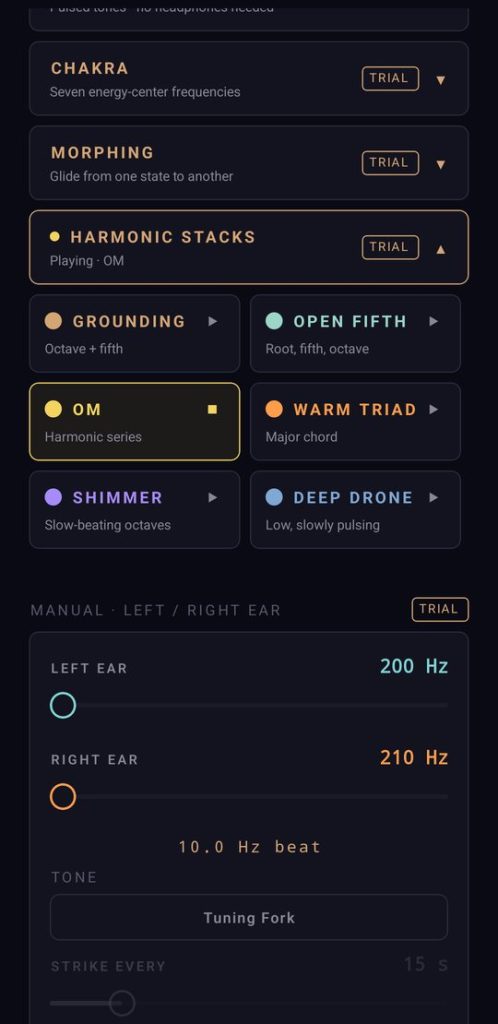
The six stacks
- Grounding — 108 Hz with its octave and twelfth. Deep and stable.
- Open Fifth — root, fifth and octave on 144 Hz. Spacious and calm.
- Om — the harmonic series on 136.1 Hz. Full and resonant.
- Warm Triad — a major chord on 128 Hz. Bright and comforting.
- Shimmer — octaves on 216 Hz, each nudged a fraction of a Hz off so they slowly beat against each other.
- Deep Drone — a low 64 Hz with a slightly detuned twin that makes it slowly pulse.
When to use them
Harmonic Stacks don’t need headphones and don’t target a brainwave band, so they’re ideal as a backdrop: yoga, stretching, journaling, a bath, or simply a quiet room. Shimmer and Deep Drone carry a slow internal pulse, so they’re a nice middle ground if you like the feeling of a beat without wearing headphones.
Hear it for yourself: every tone mentioned here has a free five-second sample on the Try It Free page.