Studying with music sounds like a good idea until the lyrics start competing with what you’re reading. Binaural beats are different: there’s nothing to follow, just a steady tone that fills the background. Here’s what the research says about beats and memory, and the routine I use as someone who’s always struggled to focus.
What the research says
The 2019 meta-analysis that pooled 22 studies found binaural beats had small-to-moderate effects on some kinds of memory and attention. Results vary a lot between studies, and nobody has found a single “study frequency” that works for everyone. So think of beats as a helpful tool for your study environment, not a shortcut to an A.
Where I think beats really help is the boring, practical stuff: blocking out noise, giving your brain a cue that it’s time to work, and making it easier to stay put for a full study block.
My story
I have ADD. Sitting still and focusing on one thing has always been hard for me. Binaural beats are the reason I built Binaural Tones. They help me focus, block out the distractions around me and stay centered. I’m not going to claim they fix ADD (they don’t, and they’re not a treatment), but they’ve made a real difference in how much I get done.
Which tones to use for studying
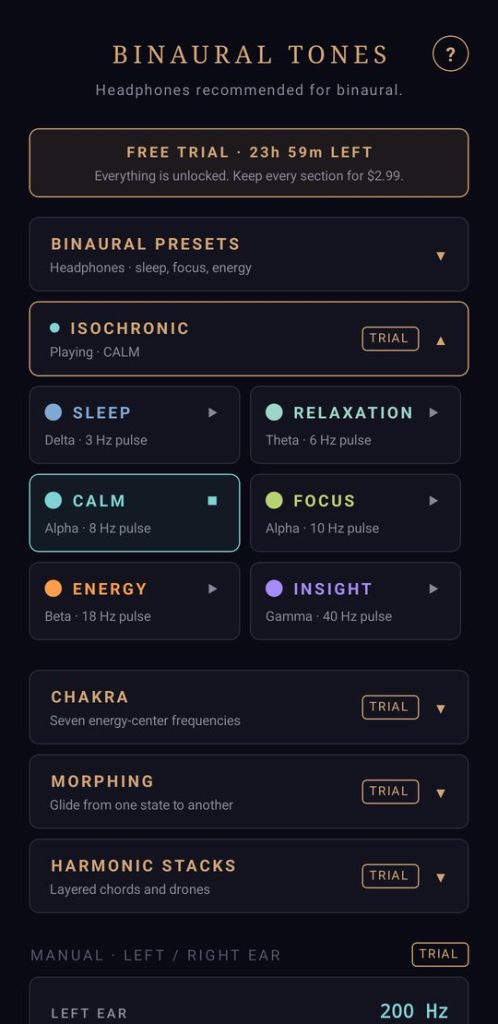
- Focus (Alpha, 10 Hz). Calm, settled attention for reading and reviewing notes.
- Energy (Beta, 18 Hz). More pace for problem sets, practice questions and writing.
- Focus In (Morphing, Alpha to Beta). Great for the first 10 minutes, when you’re still settling in.
- Isochronic Focus (10 Hz). No headphones needed, useful in a library or shared room if speakers are OK.
- Your own custom beat. Mine is 963 Hz in the left ear and 965 Hz in the right. It’s a high, bright tone I use when I need energy and focus. Build yours with the manual sliders and save it.
There’s more on focus tones in Binaural Beats for Focus.
A study routine that works
- Pick one task. Close everything else.
- Start your tone and a timer together. 25 or 50 minutes.
- Work until the timer ends. When your mind wanders, let the tone pull you back.
- Stop the tone and take a real break. Stand up, get water, look out a window.
- Repeat. After a few days, starting the tone becomes your signal to lock in.
Tips for memory
- Review before sleep. Sleep helps lock in what you learned. Do a short review, then switch to a Sleep or Wind Down tone at bedtime. Here’s how to use binaural beats for sleep.
- Keep the volume low. You want the tone in the background, not competing with your thoughts.
- Be consistent. Same tone, same desk, same time. Your brain learns the pattern.
Not sure how long a session should be? See how long, how often and when to listen.
Try it yourself
You can hear a five-second sample of every preset, free, on the Try It page. If you want the full experience, download Binaural Tones on Google Play. Everything is unlocked for your first 24 hours. Try everything, then let me know what you thought.
Binaural Tones is a relaxation and focus aid, not a medical treatment. This post is general information, not medical advice. If you have epilepsy or any condition affected by sound, check with your doctor before using it.