

Of all the ways people use binaural beats, sleep is the most popular. It’s also where a few small choices make a big difference. Here’s a routine that works for a lot of people.
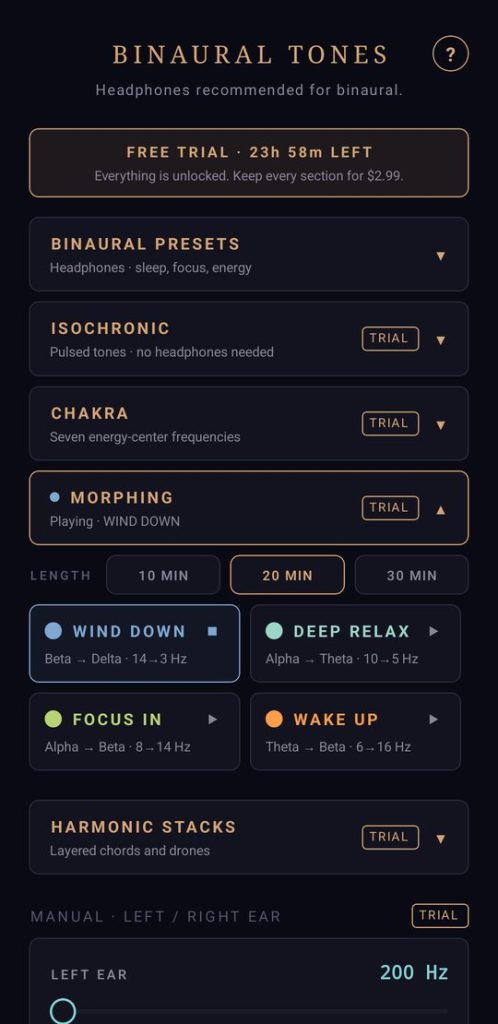
1. Pick your tone
- Sleep (Delta, 3.5 Hz) — the straightforward choice. Start it when you get into bed.
- Wind Down (Morphing, Beta → Delta) — best if your mind is still racing. It starts at a busier 14 Hz that matches where you are, then glides down to 3 Hz over 10, 20 or 30 minutes and holds there.
- Gateway (Theta, 4 Hz) — for a body-scan or meditation before sleep, when you want to stay aware a little longer.
2. Get the setup right
Headphones are required for binaural tones. For bed, soft earbuds or sleep headphones built into a headband are far more comfortable than over-ear cans. If you share a bed and find headphones impossible, use the Isochronic Sleep preset on a quiet speaker instead.
Turn it down. Set the volume barely above audible. A tone you have to strain to hear is better than one that grabs your attention.
Screen off, phone face down. Binaural Tones keeps playing with the screen off, so start it and put the phone away.
3. Give it time
Let the tone run for at least 20–30 minutes. If you wake in the night, start it again rather than reaching for something to scroll.
4. Make it a cue
The biggest benefit may be habit. Use the same tone at the same time every night and it becomes part of how your body knows it’s time to sleep, the same way a familiar room or a bedtime routine does. Give it a week before you decide whether it’s helping.
The basics still matter
No sound will outwork caffeine at 4 p.m. or a phone in your face at midnight. Pair your tone with the usual sleep fundamentals: a regular schedule, a cool dark room, and some time away from screens before bed.
If you have ongoing trouble sleeping, talk to a doctor — persistent insomnia is worth getting checked. Binaural tones are a relaxation aid, not a treatment.
Hear it for yourself: every tone mentioned here has a free five-second sample on the Try It Free page.