If you’ve spent any time in the frequency world, you’ve seen the claim: music tuned to 432 Hz is more natural, more relaxing and more “in tune with the universe” than the standard 440 Hz. Here’s what the debate is actually about, what the research says, and my take.
What 432 and 440 actually mean
This isn’t about a single tone. It’s about tuning. Musicians tune their instruments to a reference note, the A above middle C. Tune that A to 440 Hz and every other note falls into place around it. Tune it to 432 Hz and the whole song shifts down very slightly, about a third of a semitone. Most people can’t tell the difference unless they hear the two back to back.
Why the world uses 440 Hz
For centuries, there was no standard. Orchestras in different cities tuned anywhere from the low 400s to the mid 450s, which made life hard for touring musicians and instrument makers. In 1939, delegates from several European countries met in London and agreed on A = 440 Hz. It was adopted as an international recommendation in 1955 and formalized as a standard, ISO 16, in 1975. (More on the history.)
So 440 Hz wasn’t chosen because it’s special. It was chosen so everyone would match.
Where the 432 Hz idea comes from
Supporters say 432 Hz is closer to older tuning traditions, fits more neatly with certain number patterns, and simply feels warmer and calmer. Some of the stories you’ll find online, like claims about Nazi conspiracies behind 440 Hz, don’t hold up to the history above. But the core claim, that 432 Hz feels more relaxing, is something people can test.
What the research shows
There isn’t much. One of the best-known studies is a 2022 study of 54 healthcare workers. Anxiety dropped in every group that listened to music, but the 432 Hz group showed the biggest drops in breathing rate and systolic blood pressure. It’s interesting, but it’s one small study, and it can’t tell us whether 432 Hz is better for everyone or why.
The honest summary: there’s a hint of something, nothing proven, and a lot of room for personal preference.
My take
I’m open to the idea that some frequencies feel better than others. I believe frequency matters, and I believe the way you use it matters even more: your intention, your focus and your state of mind when you listen. If 432 Hz music helps you relax, that’s a good enough reason to listen to it.
What I’d push back on is the idea that 440 Hz music is harmful. There’s no evidence of that, and it’s the tuning used in almost every song you’ve ever loved.
How 432 Hz relates to binaural beats
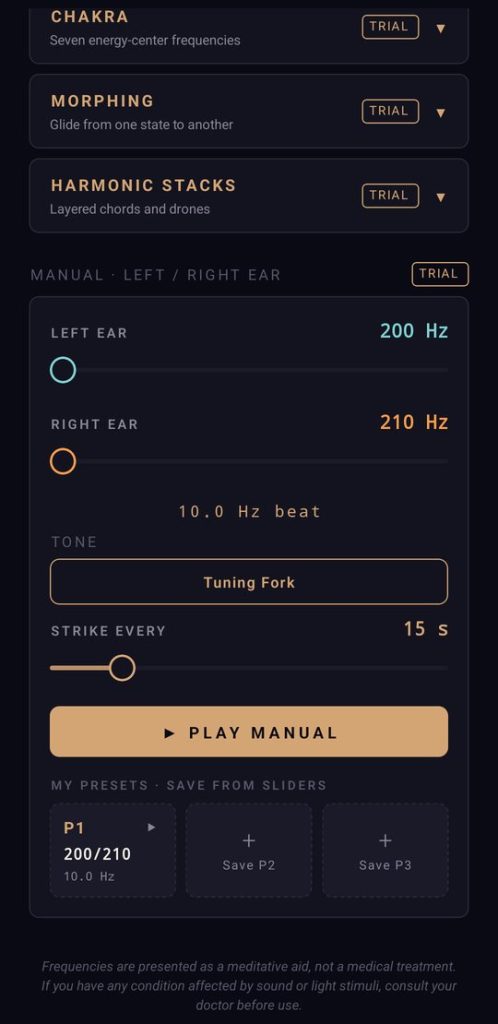
A binaural beat cares about the gap between your two ears, not the exact tone. You could build a 10 Hz Alpha beat on 432 Hz (432 in one ear, 442 in the other) or on 200 Hz. That’s exactly why I built manual sliders into Binaural Tones: set each ear to whatever you want, from 0 to 10,000 Hz, and save your favorite combinations as personal presets. If you love 432, build your beats around it.
Keep reading
- 528 Hz, 963 Hz and Other “Miracle” Frequencies: What’s Real
- Binaural Beats vs. “Healing Frequencies”: What’s the Difference?
- Combining Frequencies: Layers, Stacks and Building Your Own Binaural Beats
Try it yourself
You can hear a five-second sample of every preset, free, on the Try It page. If you want the full experience, download Binaural Tones on Google Play. Everything is unlocked for your first 24 hours. Try everything, then let me know what you thought.
Binaural Tones is a relaxation and focus aid, not a medical treatment. This post is general information, not medical advice. If you have epilepsy or any condition affected by sound, check with your doctor before using it.